Do You Need Whole-Home Surge Protection in Cartersville, GA?
A Power Surge Can Start Inside or Outside Your Home
When most homeowners hear the words “power surge,” they immediately picture a lightning strike hitting the house during a severe storm. Lightning can certainly cause damaging electrical surges, but it is only one possible source. Smaller surges can happen much more often and may begin inside the home when large appliances, heating and cooling equipment, or other high-powered devices cycle on and off.
For homeowners in Cartersville, GA, whole-home surge protection can provide an added layer of defense for the electrical equipment used every day. Modern homes contain more sensitive electronics than ever before. Televisions, computers, refrigerators, smart thermostats, security systems, internet equipment, and even newer heating and cooling systems rely on electronic controls that may be affected by sudden changes in voltage.
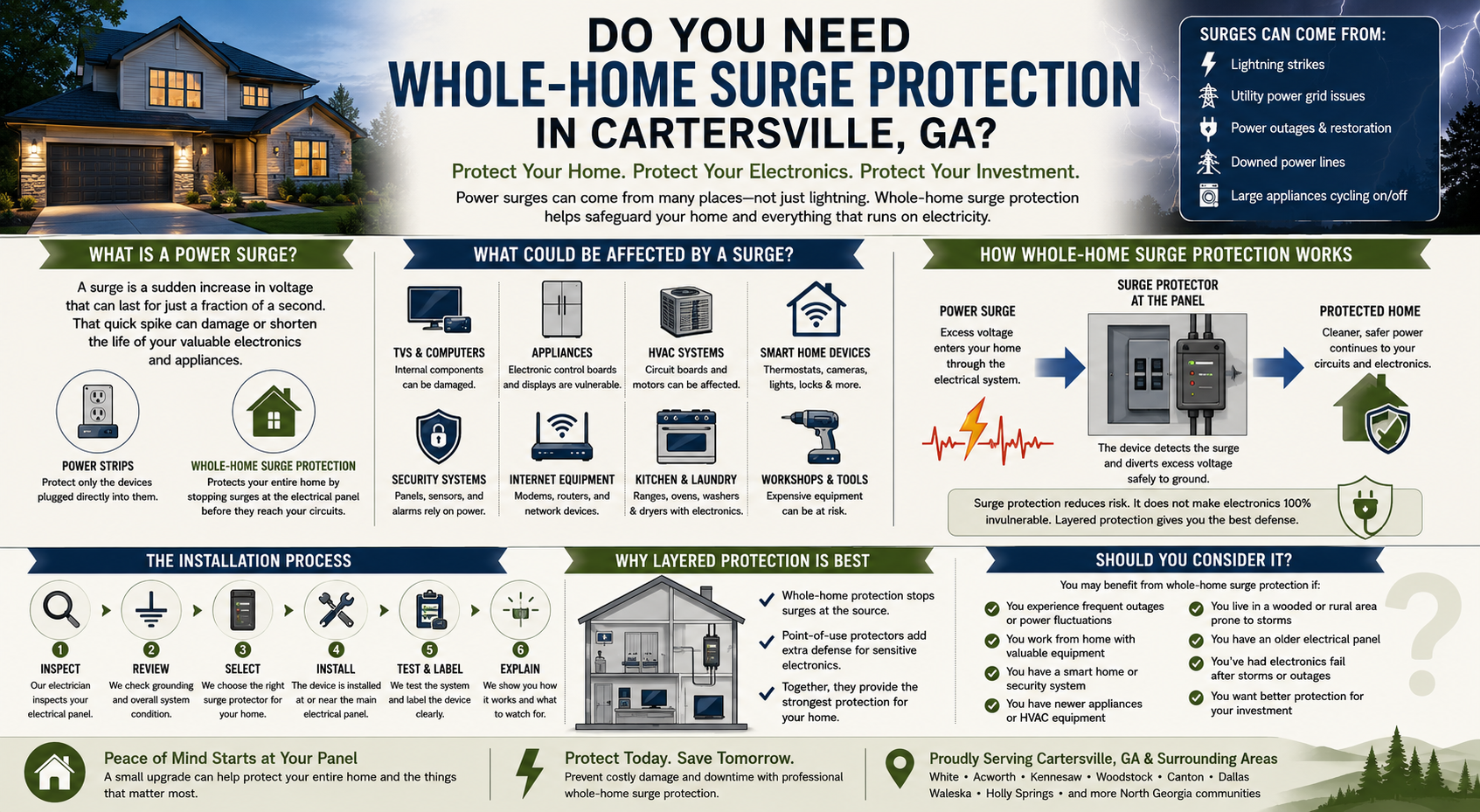
An electrical surge is a brief increase in voltage moving through the wiring system. The spike may last only a fraction of a second, but that can still be enough to damage internal components. A strong surge may cause an appliance or electronic device to stop working immediately. Smaller surges may not create obvious damage at first, but repeated exposure can gradually shorten the life of sensitive equipment.
Surges can enter the home from the utility system, nearby lightning activity, damaged power lines, or the restoration of electricity after an outage. They can also originate inside the home. When a large appliance such as an air conditioner, refrigerator, freezer, or electric motor starts or stops, it can create a change in electrical demand. The home’s electrical system is designed to handle normal operation, but added surge protection can help manage unexpected voltage spikes.
What Could Be Affected by an Electrical Surge?
Many homeowners think only of computers and televisions when discussing surge protection. Those devices are important, but they represent only part of the electronics connected throughout a modern home. Appliances that once relied mainly on mechanical components now often contain circuit boards, digital controls, sensors, displays, and connected features.
Equipment that may be affected by a power surge includes:
- Televisions, computers, and gaming systems: These devices contain sensitive internal components that may be damaged by sudden voltage changes.
- Refrigerators, ovens, and laundry appliances: Modern appliances often use electronic control boards, touchscreens, and sensors.
- Heating and cooling equipment: HVAC systems may include circuit boards, thermostats, variable-speed motors, and other electronic controls.
- Smart-home devices: Cameras, doorbells, lighting controls, thermostats, hubs, and voice assistants remain connected to the electrical system.
- Security and fire-alarm equipment: These systems may rely on powered control panels, sensors, and communication devices.
- Internet and networking equipment: Modems, routers, switches, and connected storage devices may all be vulnerable.
- Workshop and specialty equipment: Tools, chargers, compressors, and electronic controllers can represent a significant investment.
The cost of replacing a single damaged device may be manageable, but multiple losses during the same electrical event can become expensive quickly. There may also be inconvenience beyond the replacement cost. A damaged refrigerator can lead to spoiled food, while a failed modem or computer can interrupt remote work. Problems with HVAC equipment may be especially disruptive during hot Georgia weather.
It is also important to understand that not every power strip provides meaningful surge protection. Some products are simply extension devices that offer additional outlets. A true point-of-use surge protector should be clearly labeled for that purpose and include electrical ratings. Even then, it only protects the devices plugged directly into it.
Whole-home surge protection is installed at or near the main electrical panel so it can respond before excess voltage travels farther through the home’s branch circuits. It provides broader coverage for hardwired appliances and equipment that cannot be connected to a plug-in protector. This may include HVAC systems, ranges, dishwashers, lighting circuits, and other permanently connected devices.
Whole-home protection and plug-in protectors do not have to be treated as competing options. In many homes, the strongest approach is layered protection. The device at the electrical panel helps manage surges entering or moving through the broader electrical system, while quality point-of-use protectors add another layer for especially sensitive or valuable electronics.
Surge protection cannot guarantee that every device will survive every electrical event, particularly a direct lightning strike or severe utility problem. Its purpose is to reduce exposure to damaging voltage and provide a controlled path for excess electrical energy. Homeowners should view it as part of a larger electrical-safety plan that also includes proper grounding, safe wiring, a suitable electrical panel, and professional installation.
What a Whole-Home Surge Protector Actually Does
A whole-home surge-protection device is typically installed at the main electrical panel or another approved point near the home’s electrical service. During normal operation, the device remains ready without interfering with the electricity flowing through the house. When it detects excess voltage, it reacts quickly and redirects that energy away from the connected circuits.
The exact installation depends on the electrical panel, service configuration, grounding system, and selected device. Some surge protectors are mounted externally and connected to dedicated breakers. Others may be designed to fit directly into a compatible panel. A licensed electrician can determine which option is appropriate for the home and confirm that there is adequate space and capacity for the installation.
The electrical panel should be evaluated before adding new equipment. If the panel is damaged, outdated, overcrowded, or showing signs of overheating, those concerns may need to be addressed first. Surge protection is valuable, but it should not be used to cover up broader electrical problems.
Grounding also plays an important role. A surge-protection device needs an effective path for redirecting excess electrical energy. Loose connections, improper grounding, or outdated system components can affect overall performance and safety. This is one reason installation should involve more than simply attaching a device to the panel.
A professional evaluation and installation may include the following steps:
- Inspect the electrical panel. The electrician reviews the panel’s condition, available breaker space, service rating, and visible signs of wear or damage.
- Review grounding and bonding. The grounding system and major electrical connections are checked for obvious concerns.
- Select an appropriate surge device. The equipment should be compatible with the electrical system and suitable for the level of protection needed.
- Install the device at the panel. The surge protector is connected according to manufacturer requirements and electrical codes.
- Test and label the installation. The electrician verifies operation and identifies the device clearly for future reference.
- Explain status indicators and replacement needs. The homeowner learns how to confirm that the device is active and when it may need service or replacement.
Many whole-home surge protectors include a light or other indicator showing whether the protective components are still functioning. Homeowners should become familiar with that indicator and check it occasionally. Surge devices can wear out after absorbing repeated or significant electrical events, which means they should not be treated as permanent equipment that never requires attention.
Why Layered Electrical Protection Works Best
Whole-home surge protection covers more of the electrical system than a plug-in unit, but homeowners may still choose to use quality point-of-use protectors for computers, televisions, home-office equipment, and other sensitive devices. Layering protection provides more than one opportunity to reduce the energy that reaches valuable electronics.
It is also wise to consider communication lines. Internet, cable, telephone, and exterior wiring may provide additional paths into the home during certain electrical events. Some specialized surge-protection products are designed for these connections. An electrician or qualified service provider can help determine whether additional protection is appropriate for the property.
Homeowners should avoid overloading plug-in surge protectors or connecting them in a chain. A surge protector should be plugged directly into a properly installed receptacle and used within its electrical rating. Extension cords and outlet adapters are not substitutes for permanent wiring when more receptacles are regularly needed.
Surge protection also does not replace circuit breakers or ground-fault and arc-fault protection. These devices perform different jobs. Circuit breakers are designed to interrupt excessive current, while ground-fault protection helps reduce shock risks in certain locations. Arc-fault protection is intended to detect dangerous electrical arcing. Surge-protection devices focus specifically on excess voltage.
A complete electrical-safety plan may include:
- A properly sized and maintained electrical panel
- Secure grounding and bonding connections
- Whole-home surge protection at the service panel
- Quality point-of-use protectors for sensitive electronics
- Appropriate circuit-breaker, GFCI, and AFCI protection
- Professional evaluation of damaged, loose, or outdated wiring
- Periodic inspection of surge-device status indicators
Installation should always be performed by a licensed electrician because the work involves the main electrical panel. Even when the device appears simple, accessing energized panel components can be dangerous. Correct installation also helps ensure that conductor length, breaker placement, grounding, and equipment compatibility meet the applicable requirements.
A professional can also identify whether the proposed surge-protection installation reveals a larger concern. An overcrowded panel, corrosion, heat damage, loose connections, or outdated equipment may require additional work. Addressing those issues at the same time can provide a safer and more reliable result than adding one device without examining the condition of the system.
For Cartersville homeowners, whole-home surge protection can be a relatively straightforward electrical upgrade when the panel and wiring are in suitable condition. The installation offers broader coverage than relying only on power strips and supports the growing number of electronics, appliances, and connected systems used throughout the home.
Homes That May Benefit Most From Surge Protection
Almost any modern home can benefit from surge protection because nearly every household contains electronic equipment. However, some properties may have greater exposure, more valuable equipment, or electrical conditions that make the upgrade especially worth discussing with an electrician.
Homes with frequent outages or noticeable power fluctuations may experience more opportunities for voltage changes. Rural, wooded, or developing areas can also be affected by storms, falling trees, utility work, and service interruptions. Homes with overhead utility lines may have different exposure than properties served through underground lines, although neither arrangement completely eliminates surge risk.
Home offices are another consideration. Computers, monitors, printers, networking equipment, external drives, and communication devices may all be operating at the same time. A damaging surge could affect both the equipment and the homeowner’s ability to work. Whole-home protection combined with quality point-of-use protection can create a more thoughtful setup for these spaces.
Smart homes may contain dozens of connected devices, including thermostats, cameras, lighting controls, appliances, locks, speakers, and security systems. Individually, some of these products may not be extremely expensive. Replacing multiple devices and reconnecting the entire system, however, can be time-consuming and costly.
Homes with upgraded kitchens, workshops, entertainment systems, electric-vehicle charging equipment, or high-efficiency HVAC systems may also have significant electrical investments. Surge protection does not eliminate the need for proper circuits and installation, but it can add another layer of protection for the equipment connected to those systems.
Homeowners may want to ask an electrician about whole-home surge protection when the property has:
- Frequent utility outages or power-restoration events
- A home office with multiple computers and networking devices
- Smart-home systems or extensive security equipment
- Newer appliances with electronic control boards
- Expensive HVAC, workshop, or entertainment equipment
- A recently upgraded or replaced electrical panel
- A history of electronics failing after storms or outages
- Plans for additional electrical upgrades or renovations
Certain warning signs should lead to a broader electrical inspection rather than an assumption that surges are the only problem. Flickering lights, burning odors, warm outlets, buzzing sounds, repeated breaker trips, or visible panel damage may indicate loose wiring, overloaded circuits, failing equipment, or other safety concerns.
A surge protector will not repair these issues. Homeowners should describe all symptoms to the electrician so the full electrical system can be evaluated. Correcting the underlying concern should take priority before or alongside the surge-protection installation.
Ask a Cartersville Electrician About the Right Upgrade
Choosing a whole-home surge protector should be based on the electrical system and household needs rather than selecting the first device available. Electrical panels vary by manufacturer, age, service rating, configuration, and available space. The electrician should choose equipment that is compatible with the panel and install it according to the manufacturer’s instructions.
During the consultation, homeowners can ask questions such as:
- Is the current electrical panel in good condition?
- Is there enough space and capacity for the installation?
- Does the grounding system need any improvements?
- What type of surge-protection device is recommended for this home?
- Does the device include a visible status indicator?
- Should sensitive electronics still use point-of-use surge protectors?
- How will the homeowner know when the device needs replacement?
- Are there any other electrical concerns that should be corrected first?
Homeowners should also discuss future plans. If a panel upgrade, home addition, kitchen renovation, EV charger, generator connection, or other electrical project is being considered, it may be helpful to coordinate the work. Planning related upgrades together can reduce duplicated labor and make sure the electrical system is prepared for the home’s changing needs.
BrightGuard Property Solutions provides residential electrical services and specialty electrical upgrades for homeowners in Cartersville, GA, and nearby North Georgia communities. Service areas include White, Acworth, Kennesaw, Woodstock, Canton, Dallas, Waleska, Holly Springs, and surrounding locations.
A professional electrical evaluation can help determine whether whole-home surge protection is appropriate for the property and whether the panel, grounding, or wiring needs attention. The goal is not simply to install another device. It is to make sure the protection is compatible with the electrical system and installed in a way that supports safe, reliable operation.
Whole-home surge protection can be a practical upgrade for households that depend on electronics, smart systems, modern appliances, and connected equipment. It provides broader coverage than standard plug-in protectors and can help reduce the electrical stress caused by sudden voltage spikes.
If you are concerned about power surges or want to strengthen your home’s electrical protection, contact BrightGuard Property Solutions to schedule an evaluation in Cartersville, GA. A licensed electrician can inspect the electrical panel, review the grounding system, explain the available surge-protection options, and recommend an upgrade suited to your home.
Recent Posts